
Understanding the Moon’s Phases: A Guide to the Lunar Cycle
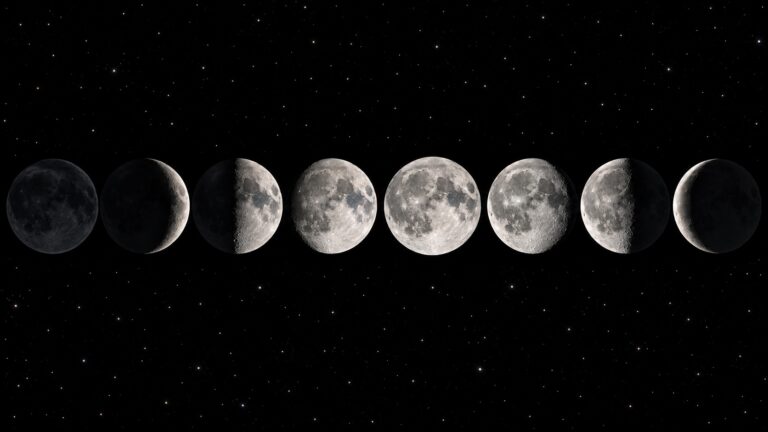
The Moon is always changing. On some nights it appears as a thin crescent near the horizon. On others it becomes a brilliant circle that lights the landscape until morning. Between these familiar shapes are several phases that repeat in a dependable cycle.
People have followed the predictable cycle of moon phases for thousands of years. The changing Moon helped early communities measure time, organize calendars, plan religious observances, and mark agricultural seasons. Its appearances inspired stories about gods, goddesses, animals, immortality, and transformation.
Today, we understand the astronomy behind the lunar cycle, but that knowledge has not made the Moon any less fascinating. Every phase offers a different view of our nearest celestial neighbor.
Why Does the Moon Have Phases?
The Moon does not create its own visible light. It shines because it reflects sunlight.
At any given moment, the Sun illuminates half of the Moon. As the Moon travels around Earth, we see different portions of that illuminated half. These changing views create the lunar phases.
The moon phases are not caused by Earth’s shadow. Earth’s shadow falls across the Moon only during a lunar eclipse. Ordinary phases result from the changing positions of the Sun, Earth, and Moon.
When the Moon is positioned in approximately the same direction as the Sun, its bright side faces mostly away from us. This is the new moon.
As the Moon continues along its orbit, more of the sunlit half becomes visible from Earth. The Moon grows from a crescent to a half moon, then to a gibbous moon and finally a full moon.
After the full moon, the process reverses. The illuminated portion appears to shrink until the Moon becomes new again.
How Long Is the Lunar Cycle?
The complete cycle from one new moon to the next takes approximately 29.53 days. Astronomers call this the synodic month.
The Moon actually completes one orbit relative to the background stars in about 27.3 days. This is known as the sidereal month.
The two periods are different because Earth is also moving around the Sun. After the Moon completes one orbit around Earth, it must travel a little farther to return to the same alignment with Earth and the Sun.
This is why the moon phase cycle takes about two days longer than the Moon’s basic orbital period.
The lunar cycle is close to the length of a calendar month, but the two do not match exactly. This allows some calendar months to contain two full moons or two new moons.
The Eight Phases of the Moon
Astronomers commonly divide the lunar cycle into eight named phases. The changes between them are continuous, so the Moon does not suddenly jump from one shape to another. Each phase gradually develops into the next.
New Moon
The new moon begins the commonly recognized lunar cycle.
During this phase, the Moon is positioned between Earth and the Sun. Its sunlit half faces mostly away from Earth, so the Moon is normally invisible against the bright daytime sky.
A new moon rises around sunrise, crosses the sky during the day, and sets around sunset. It is usually lost in the Sun’s glare.
The nights surrounding the new moon provide the darkest skies of the month. This makes them ideal for observing faint stars, galaxies, nebulae, and meteor showers.
A solar eclipse can occur only during a new moon. However, most new moons do not produce eclipses because the Moon’s orbit is tilted by about five degrees compared with Earth’s orbit around the Sun. The Moon usually passes above or below the Sun from our viewpoint.
Waxing Crescent Moon
A few days after the new moon, a thin crescent appears low in the western sky after sunset.
The word “waxing” means that the visible illuminated portion is growing. Each evening, the crescent becomes wider and remains in the sky longer.
The waxing crescent is one of the most beautiful lunar phases. Its bright curve may be accompanied by a faint gray glow across the rest of the Moon. This glow is called earthshine.
Earthshine is sunlight that reflects from Earth to the Moon and then back toward us. In a sense, Earth is lighting the Moon’s night side.
The waxing crescent is best observed during the early evening. It sets a few hours after the Sun.
First-Quarter Moon
At first quarter, the Moon is one-quarter of the way through its cycle. Despite the name, it appears half illuminated from Earth.
The first-quarter Moon rises around noon, becomes prominent during the afternoon, and remains visible through the evening. It sets around midnight.
This is one of the best phases for observing the lunar surface. Along the boundary between lunar daylight and darkness, mountains and crater walls cast long shadows.
That boundary is called the terminator. The shadows near it make the Moon’s surface appear rugged and three-dimensional.
Binoculars can reveal large craters and dark plains. A small telescope provides close views of mountain ranges, lava-filled basins, and overlapping impact scars.
Waxing Gibbous Moon
After first quarter, more than half of the Moon appears illuminated. This is the waxing gibbous phase.
The word “gibbous” describes a shape that is larger than a semicircle but not yet completely round.
A waxing gibbous Moon rises during the afternoon and remains visible for much of the night. It becomes brighter and fuller each evening.
This phase provides good views of many lunar features. The terminator continues moving across the surface, revealing new craters and ridges each night.
The bright Moon also begins washing out fainter stars. Astronomers planning to observe galaxies or meteor showers usually prefer a darker phase.
Full Moon
The full moon occurs when Earth is positioned approximately between the Sun and Moon. The entire Earth-facing side appears illuminated.
A full moon rises around sunset, reaches its highest point near midnight, and sets around sunrise. It remains visible throughout the night.
The full moon is visually impressive, but it is not always the best phase for examining craters. Sunlight strikes the center of the visible lunar surface almost directly, creating shorter shadows. The landscape can appear flatter than it does during crescent or quarter phases.
The edges of the lunar disk can still show useful shadow detail. Bright ray systems surrounding younger impact craters also become prominent near full moon.
A lunar eclipse can occur only during a full moon. During an eclipse, the Moon passes into Earth’s shadow. The Moon may turn copper, orange, or red because sunlight filtered through Earth’s atmosphere reaches the lunar surface.
Most full moons do not produce eclipses because the Moon usually passes above or below Earth’s shadow.
Waning Gibbous Moon
After the full moon, the illuminated portion begins to decrease. This starts the waning half of the cycle.
A waning gibbous Moon rises later in the evening and remains visible after sunrise. It is often high in the western sky during the morning.
Many people overlook the daytime Moon, but the waning gibbous phase can be easy to see after sunrise. Its pale disk remains visible against the blue sky.
The changing sunlight also brings shadows back to lunar features that appeared flat during the full moon.
Last-Quarter Moon
At last quarter, the Moon again appears half illuminated. The opposite half is bright compared with the first-quarter phase.
The last-quarter Moon rises around midnight, reaches its highest point near sunrise, and sets around noon.
This phase is ideal for early risers. The Moon is often high in the sky before sunrise, when the atmosphere may be calm and steady.
Features along the terminator are illuminated from the opposite direction compared with first quarter. Familiar craters can look surprisingly different when their shadows fall the other way.
Last quarter is also called third quarter because the Moon has completed about three-quarters of its phase cycle.
Waning Crescent Moon
During the final days of the cycle, the Moon becomes a thin waning crescent.
It rises shortly before sunrise and appears low in the eastern sky during morning twilight. Each day, the crescent becomes thinner and moves closer to the Sun’s position.
A delicate waning crescent can be a rewarding sight for early risers. It is sometimes joined by bright planets such as Venus or Mercury.
Eventually, the crescent disappears into the Sun’s glare. The Moon returns to its new phase, and the cycle begins again.
Why Does Moonrise Change Every Day?
The Moon generally rises about 50 minutes later each day. The exact difference varies according to the season, latitude, and angle of the Moon’s orbit.
This daily change occurs because the Moon moves eastward in its orbit around Earth. Our planet must rotate a little farther each day before the Moon returns to the same position in the sky.
The connection between phase and rising time is predictable. A waxing crescent follows the Sun into the western evening sky. A full moon rises as the Sun sets. A last-quarter Moon rises around midnight. A waning crescent appears before sunrise.
Knowing the phase can therefore help you predict when and where to look for the Moon.
The Terminator Is the Best Place to Explore
The most dramatic lunar scenery is often found near the terminator.
Sunlight strikes the ground at a low angle along this boundary. Crater rims, mountains, cliffs, and ridges cast long shadows. Small differences in elevation become much easier to see.
The terminator moves across the Moon throughout the month. A crater hidden in darkness one evening may emerge into sunlight the next.
Observing the Moon on several consecutive nights provides a sense of sunrise or sunset moving across another world. The changes can be noticeable even through ordinary binoculars.
The full moon may be the brightest phase, but crescent and quarter moons often reveal more surface texture.
The Moon Is Often Visible During the Day
Many people associate the Moon only with nighttime, but it spends almost as much time in the daytime sky.
A first-quarter Moon is visible during the afternoon. A waning gibbous Moon often remains in the sky after sunrise. The last-quarter Moon can be seen throughout the morning.
The Moon becomes difficult to see when it is close to the new phase because it appears near the Sun. It is also absent from the daytime sky near full moon because it is on the opposite side of Earth from the Sun.
Seeing the Moon during the day is normal. It does not mean anything unusual has occurred in its orbit.
How the Moon Affects Ocean Tides
The Moon’s gravity is the primary force behind Earth’s ocean tides. The Sun also contributes.
The Moon’s gravity pulls more strongly on the side of Earth closest to it and less strongly on the far side. This difference helps create tidal bulges. As Earth rotates, coastlines move through these regions of higher and lower water.
During new and full moons, the Sun, Earth, and Moon are approximately aligned. The gravitational effects of the Sun and Moon combine to create a greater difference between high and low tides. These are called spring tides.
Spring tides have nothing to do with the season of spring. The name refers to the water appearing to spring higher than usual.
During first and last quarters, the Sun and Moon pull from roughly right angles. Their effects partially counteract each other, producing a smaller tidal range. These are called neap tides.
Local geography strongly affects actual tides. Coastlines, bays, ocean depth, wind, and atmospheric pressure can change their timing and height.
Why Do We Always See the Same Side?
The Moon rotates on its axis, even though it may not appear to do so.
It takes about 27.3 days to rotate once. It also takes about 27.3 days to complete one orbit around Earth. Because these periods match, nearly the same side of the Moon always faces us.
This condition is called synchronous rotation or tidal locking.
Long ago, the Moon rotated more quickly. Earth’s gravity created tidal distortions within it. Friction gradually slowed the Moon’s rotation until its spin matched its orbit.
The hemisphere facing Earth is called the near side. The hemisphere facing away is called the far side.
The far side is sometimes incorrectly called the dark side of the Moon. It is not permanently dark. Both sides experience roughly two weeks of daylight followed by two weeks of darkness.
Why We Can See More Than Half the Moon
Although the same general hemisphere faces Earth, the Moon appears to rock gently from side to side and up and down. This apparent motion is called libration.
Libration occurs because the Moon’s orbit is elliptical, its axis is tilted, and our viewpoint changes as Earth rotates.
Over time, libration allows observers to see approximately 59 percent of the lunar surface. We can never see all of it at once, but small regions near the edges come into view at different times.
Careful lunar observers use favorable libration to glimpse craters and mountains that are normally hidden near the Moon’s edge.
Perigee, Apogee, and the Supermoon
The Moon’s orbit is not a perfect circle.
Perigee is the point in the orbit where the Moon is closest to Earth. Apogee is the point where it is farthest away.
The Moon looks slightly larger at perigee and slightly smaller at apogee. When a full moon occurs near perigee, it is popularly called a supermoon.
“Supermoon” is not a strict scientific classification. Different calendars use different distance limits when deciding which full moons qualify.
A supermoon can look somewhat larger and brighter than a distant full moon, but the difference is less dramatic than many photographs suggest. Most people would have difficulty recognizing the difference without comparing images taken with the same equipment.
Why the Moon Looks Enormous Near the Horizon
A rising full moon can look enormous beside trees, buildings, or distant hills. Later, when it is high in the sky, it seems smaller.
This is called the Moon illusion.
The Moon’s actual apparent size changes very little during the night. Photographs made with the same lens settings confirm that the lunar disk remains nearly the same size.
The illusion appears to be related to how the brain judges objects near the horizon. Familiar landscape features provide a sense of distance and scale, making the Moon seem larger.
The effect is psychological rather than astronomical, but it remains one of the most convincing visual illusions in nature.
Why a Rising Moon Looks Orange
The Moon often appears yellow, orange, or red near the horizon.
When the Moon is low, its light travels through a greater thickness of Earth’s atmosphere. Air molecules and particles scatter more of the shorter blue wavelengths, allowing warmer colors to dominate.
The Moon usually becomes whiter as it rises higher. Smoke, dust, haze, and air pollution can deepen its color.
The same atmospheric process helps create colorful sunrises and sunsets.
The Moon as Humanity’s First Calendar
The Moon’s repeating phases gave early societies a visible and dependable way to measure time.
The English words “moon” and “month” have related linguistic origins. A lunar cycle is close to the length of a month, although the modern Gregorian calendar no longer follows the Moon precisely.
Some calendars remain closely connected with lunar phases.
The Islamic calendar is lunar. Its months begin with the appearance or calculated arrival of the crescent Moon. Because twelve lunar months are shorter than a solar year, Islamic holidays move through the seasons over time.
The traditional Hebrew calendar is lunisolar. Its months follow the Moon, while occasional leap months keep the calendar aligned with the solar year and agricultural seasons.
The traditional Chinese calendar is also lunisolar. It helps determine Lunar New Year and the Mid-Autumn Festival.
The date of Easter is calculated through a calendar system connected with the first full moon after the March equinox.
The Moon still helps determine religious observances and cultural celebrations around the world.
Selene and Luna
Ancient cultures often imagined the Moon as a deity traveling across the sky.
In Greek tradition, Selene personified the Moon. She was commonly described driving a shining chariot through the night.
One of her best-known stories concerns Endymion, a beautiful mortal placed into an eternal sleep. Selene visited him as he slept, creating a story that connected the Moon with night, dreams, beauty, and unchanging love.
The Romans knew the lunar goddess as Luna. Her name survives in words such as lunar.
Artemis in Greek tradition and Diana in Roman tradition also became associated with the Moon. Their identities were not originally the same as Selene and Luna, but their roles became connected over time.
Chang’e and the Jade Rabbit
In Chinese mythology, Chang’e is the goddess of the Moon.
Several versions of her story describe her drinking an elixir of immortality and rising to the Moon. She is often accompanied by the Jade Rabbit, who prepares an elixir with a mortar and pestle.
Chang’e is closely associated with the Mid-Autumn Festival. Families gather, admire the full moon, light lanterns, and share mooncakes.
China’s lunar exploration program is named Chang’e. The robotic missions connect an ancient cultural figure with modern scientific exploration.
Lunar Figures Around the World
The Moon has inspired many other religious and mythological figures.
Tsukuyomi is a lunar deity in Japanese mythology. Unlike many European moon figures, Tsukuyomi is generally presented as male.
In ancient Egyptian religion, Khonsu was associated with the Moon’s passage across the sky. Thoth, the god of writing, knowledge, measurement, and time, also had strong lunar connections.
In Hindu traditions, Chandra is a lunar deity connected with night, fertility, and the measurement of time.
Different cultures have seen rabbits, people, trees, frogs, and other figures in the Moon’s dark plains. These patterns are examples of pareidolia, the human tendency to recognize familiar shapes in natural features.
The Man in the Moon
In many European traditions, people imagined a human face or figure in the full moon.
The dark areas forming these patterns are broad plains called maria. The word is Latin for “seas.” Early astronomers believed these dark regions might contain water.
The maria are actually ancient basins filled with dark volcanic rock. Massive impacts created the basins, and lava later flowed across their floors.
Different cultures interpreted the same markings in different ways. Some saw a man carrying sticks. Others saw a rabbit, a woman, or an animal.
The Moon’s surface did not change, but the stories reflected the communities observing it.
Does the Full Moon Affect Human Behavior?
The full moon has long been associated with sleeplessness, emotional changes, unusual behavior, crime, and transformation.
The word “lunatic” comes from luna, the Latin name for the Moon. Werewolf stories also became linked with the full moon in later literature and popular culture.
Modern scientific studies have not found a reliable general connection between the full moon and increases in crime, psychiatric emergencies, births, or broadly unusual human behavior.
The full moon can affect nighttime brightness. Before electric lighting, it provided enough illumination to extend outdoor work, travel, and social activity. Brighter nights can also influence some animals.
The Moon clearly affects tides and several natural behaviors, but claims that it directly controls human actions should be presented as folklore rather than established science.
How to Observe the Lunar Cycle
You do not need a telescope to follow the Moon.
Begin by recording the Moon’s shape, location, and rising time. Observe it every few evenings if the weather allows. Notice how it moves eastward against the background stars and rises later each day.
Binoculars reveal large craters, dark maria, bright highlands, and rugged terrain along the terminator.
A small telescope can show hundreds of individual features. Use lower magnification first, then increase the power when the atmosphere is steady.
The Moon can be uncomfortably bright through a telescope near its full phase. A lunar filter can reduce glare, although it is not required for safety. Looking at the Moon through a telescope will not damage your eyes.
Never use binoculars or a telescope to look near the Sun unless the instrument has a professionally manufactured solar filter securely attached to its front opening.
A Different Moon Every Night
The Moon’s cycle is predictable, but it never feels entirely repetitive.
A waxing crescent glows above the evening horizon. A first-quarter Moon reveals long crater shadows. A full moon illuminates the landscape. A waning crescent appears quietly before sunrise.
Each phase shows the same world under different lighting.
The lunar cycle connects astronomy with daily life. It affects tides, helps produce eclipses, guides calendars, and changes the darkness of the night sky. It has also inspired stories about love, immortality, knowledge, transformation, and time.
Watching the Moon does not require rare equipment or a journey to a remote location. It only requires looking up often enough to notice the pattern.
Follow it for one complete month. Watch the crescent grow, the full moon rise, and the bright disk slowly fade into the morning sky. By the time the cycle begins again, the Moon will no longer seem like a fixed object overhead. It will feel like a neighboring world in constant motion.
Please be advised that, despite our best efforts, International Star Registry – Name a star provides astronomical content for entertainment purposes. We cannot guarantee the accuracy of all information given.