
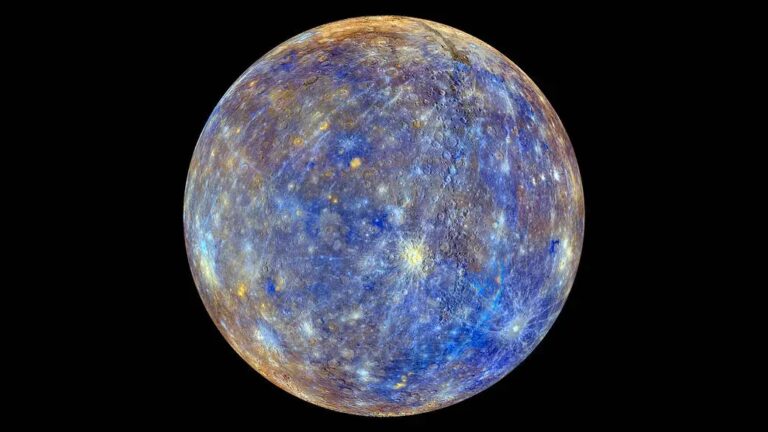
Mercury and Saturn with the Crescent Moon: A Rare Double Event in the Evening Sky
February 19, 2026, brings skywatchers a rare double celestial treat. On this remarkable evening, Mercury reaches its greatest eastern elongation, standing 18 degrees from the Sun, while a delicate crescent Moon passes near Saturn in the twilight sky. One event showcases the elegant precision of orbital mechanics. The other offers pure visual poetry.
For observers near 40 degrees north latitude, including much of the continental United States, southern Europe, and parts of Asia, this will be the best evening appearance of Mercury in 2026.
If you have ever struggled to spot the elusive innermost planet, this is your moment.
Why Mercury Is So Difficult to See
Mercury is the smallest planet in our solar system and the closest to the Sun. With a radius of just 1,516 miles or 2,440 kilometers, it is only slightly larger than Earth’s Moon. According to NASA, If Earth were the size of a nickel, Mercury would be about as big as a blueberry.
Because Mercury orbits so close to the Sun, it never strays far from our star in the sky. It is usually lost in solar glare and visible only briefly during twilight.
That is why moments like Mercury’s greatest elongation are so important.
What Is Greatest Eastern Elongation
On February 19, 2026, Mercury reaches its greatest eastern elongation, meaning it appears at its maximum angular separation from the Sun in the evening sky.
The angular separation will measure 18 degrees from the Sun. Looking from the US, Mercury will stand nearly 17 degrees above the horizon at sunset when you look toward the constellations Aquarius and Pisces in the Western Sky. The normally shy planet will shine at magnitude -0.4 to -0.2 and will not set until more than one and a half hours after the Sun.
What makes this event extraordinary is the geometry. Mercury will climb vertically above the western horizon instead of hugging it. Even more exciting, Mercury will remain visible after the end of astronomical twilight. In other words, it will shine in a genuinely dark sky, which is rare for this planet.
This combination makes it the finest evening showing of Mercury in 2026.
When to Watch on February 18 and 19, 2026
On the evening of February 18, about 45 minutes after sunset, look low toward the west southwest. You will see a slender waxing crescent Moon, just one and a half days past new and only about 2 percent illuminated. The thin crescent will resemble a slim smile suspended in twilight.
Hovering directly above it will be a bright point of light. That is not a star. It is Mercury.
This pairing makes locating Mercury much easier because the Moon acts as a guidepost in the fading light. The best viewing window will be around 6:00 to 6:30 PM EST. The view will be beautiful to the naked eye, and binoculars will enhance the contrast.
On February 19, Mercury’s greatest elongation occurs in the afternoon between 2:00 and 3:00 PM EST. Although the peak separation happens during daylight hours, the planet becomes visible shortly after sunset. That evening, Mercury stands at its highest and brightest evening placement of the year.
At the same time, a thin crescent Moon will pass near Saturn, creating a graceful alignment in the western sky. The Moon Saturn pairing will be best viewed during twilight, again around 6:00 to 6:30 PM EST.
Both evenings promise magical pairings between planet and moon
Why This Is the Best Evening Appearance of Mercury in 2026
Several factors combine to make this event exceptional. Mercury rises high above the horizon at sunset. It remains visible long after the Sun goes down. It shines brightly at magnitude up to -0.4. Most importantly, it becomes visible after astronomical twilight ends, allowing observers to see it against a dark sky.
Mercury is often swallowed by haze and atmospheric turbulence near the horizon. This time, it climbs high enough to escape much of that distortion.
For observers near 40 degrees north latitude, the geometry is especially favorable.
Understanding Mercury the Swift Planet
Mercury is appropriately named for the swiftest of the ancient Roman gods. It zips around the Sun every 88 Earth days, traveling nearly 29 miles or 47 kilometers per second. That makes it the fastest planet in our solar system.
Its orbit is highly eccentric and egg shaped, appearing from Earth to “retrograde” several times a year. Mercury travels as close as 29 million miles or 47 million kilometers from the Sun and as far as 43 million miles or 70 million kilometers away. On average, it sits about 36 million miles or 58 million kilometers from the Sun, which equals 0.4 astronomical units. Sunlight takes only 3.2 minutes to travel from the Sun to Mercury.
A World of Extremes
Mercury’s environment is one of the most extreme in the solar system.
Daytime temperatures can soar to 800 degrees Fahrenheit or 430 degrees Celsius. At night, without an atmosphere to retain heat, temperatures can plunge to minus 290 degrees Fahrenheit or minus 180 degrees Celsius.
Despite its proximity to the Sun, Mercury is still not the hottest planet. That title belongs to Venus, whose dense atmosphere traps heat efficiently.
Mercury has no substantial atmosphere, only a thin exosphere composed mostly of oxygen, sodium, hydrogen, helium, and potassium. These atoms are blasted off the surface by the solar wind and impacts from meteoroids.
Because it lacks a thick atmosphere, Mercury’s surface cools rapidly after sunset.
A Day on Mercury
Mercury rotates slowly, completing one rotation every 59 Earth days. However, because of the way its orbit and rotation interact, one full solar day, meaning sunrise to sunrise, lasts 176 Earth days. That equals just over two Mercury years.
Near its closest approach to the Sun, some parts of Mercury’s surface experience a strange effect in which the Sun appears to rise, set, and rise again.
The planet’s axis is tilted only 2 degrees relative to its orbital plane. As a result, Mercury does not experience seasons like Earth does.
Surface Features and Structure
Mercury formed about 4.5 billion years ago when gravity pulled swirling gas and dust together to form this small world nearest the Sun. Like Earth, it has a central core, a rocky mantle, and a solid crust.
It is the second densest planet after Earth. Its large metallic core has a radius of about 1,289 miles or 2,074 kilometers, accounting for about 85 percent of the planet’s radius. Evidence suggests that part of this core remains molten.
The surface resembles that of Earth’s Moon, heavily scarred by impact craters from asteroids and comets. Very large impact basins include Caloris, which spans about 960 miles or 1,550 kilometers, and Rachmaninoff, which measures about 190 miles or 306 kilometers across.
Some cliffs stretch hundreds of miles and rise up to a mile high. These formed as Mercury’s interior cooled and contracted over billions of years.
Most of the surface appears grayish brown. Bright streaks known as crater rays form when impacts eject crushed rock that later settles back to the surface. Over time, space weathering darkens these rays.
There is also evidence that water ice may exist at Mercury’s north and south poles inside deep craters that remain in permanent shadow.
Mercury’s Magnetic Field
Mercury possesses a magnetic field that is about 1 percent as strong as Earth’s. It is offset relative to the planet’s equator. This magnetic field interacts with the solar wind, sometimes creating intense magnetic tornadoes that funnel charged particles down to the surface. When these particles strike the ground, they knock atoms into space, contributing to Mercury’s thin exosphere.
Tips for Successfully Observing Mercury
To improve your chances of seeing Mercury during this favorable appearance, keep a few simple guidelines in mind.
Choose a location with a clear and unobstructed view toward the west southwest horizon. Arrive before sunset, and avoid staring into the direction of the setting sun so your eyes can adjust gradually as the sky darkens. Once the Sun has set, use the crescent Moon on February 18 as a guide to help locate Mercury. Bring binoculars if you have them, though Mercury will be visible to the naked eye. Stay patient and continue watching as twilight deepens, especially on February 19 when Mercury remains visible in a darker sky.
Viewing Near 40 Degrees North Latitude
Observers near 40 degrees north latitude will enjoy the most favorable geometry. Cities near this latitude include New York City, Chicago, Denver, Madrid, and Beijing. If you live farther south, Mercury will appear somewhat lower. If you are farther north, atmospheric effects may slightly reduce clarity.
The Moon and Saturn Pairing
The second event on February 19 features a thin crescent Moon passing near Saturn in the western sky. Saturn will appear as a steady golden point of light. Through a small telescope, its rings will be visible, creating a striking sight beside the delicate crescent Moon.
This alignment offers a wonderful opportunity for photography as well as quiet visual appreciation.
A Sky Worth Watching
Mercury’s elongation reveals the graceful geometry of the inner solar system. Watching it stand high above the horizon demonstrates how orbital tilt and Earth’s latitude influence visibility. The Moon’s passage near Saturn reminds us that the sky is constantly shifting and aligning in beautiful ways.
Mark your calendar for February 18 and 19, 2026. Step outside about 45 minutes after sunset. Face the west southwest sky. Watch as a slender crescent Moon smiles over the horizon. Above it glows swift Mercury, shining boldly in the fading light. Nearby, Saturn lingers in quiet elegance.
Two nights. Two celestial events. One unforgettable sky.
Sources: Space.com, NASA
Please be advised that, despite our best efforts, International Star Registry – Name a star provides astronomical content for entertainment purposes. We cannot guarantee the accuracy of all information given.