
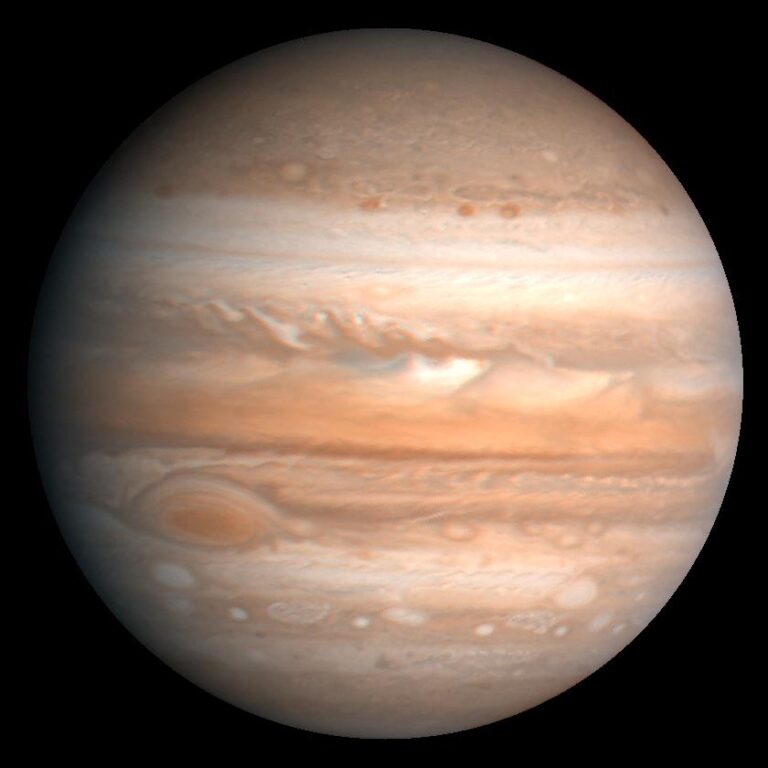
When people step outside on a clear night and look up, one of the brightest objects they may see is the planet Jupiter. It shines with a steady white light that stands out among the stars. Unlike stars, which appear to twinkle, Jupiter glows with a calm brilliance. For thousands of years, this bright planet has captured the attention of sky watchers, storytellers, and astronomers.
Jupiter is the largest planet in our solar system. Its immense size and powerful gravity make it a dominant force among the planets. Ancient observers did not know the scientific details we understand today, but they clearly recognized that Jupiter was special. Its brightness and slow movement across the sky gave it an air of importance.
Many cultures associated Jupiter with kings, rulers, and powerful gods. The Romans named the planet after Jupiter, their king of the gods. In Greek mythology the same figure was known as Zeus. These mythological connections reflected the planet’s commanding presence in the sky.
Today Jupiter remains one of the most fascinating worlds for both scientists and amateur observers. Its swirling clouds, enormous storms, and dozens of moons create a dynamic system that continues to reveal new discoveries. The story of Jupiter blends science, mythology, and centuries of human curiosity.
Jupiter in the Solar System
Jupiter is the fifth planet from the Sun. It orbits at an average distance of about 484 million miles from our star. Because it is so far from the Sun, Jupiter takes much longer to complete an orbit compared with Earth.
A year on Jupiter lasts nearly 12 Earth years. That means the planet travels slowly across the background stars from our point of view on Earth. Ancient astronomers carefully tracked this movement and recognized its repeating cycle.
Jupiter is enormous compared to the other planets. Its diameter measures about 86,881 miles. More than 1,300 Earth sized planets could fit inside Jupiter if it were hollow.
Despite its size, Jupiter is not made of solid rock like Earth. Instead it is a gas giant composed mostly of hydrogen and helium. These same elements make up most of the Sun.
Deep inside Jupiter the pressure becomes extremely intense. Scientists believe the hydrogen gas becomes compressed into a strange state known as metallic hydrogen. In this form the hydrogen behaves somewhat like a liquid metal and conducts electricity.
This internal structure helps generate Jupiter’s powerful magnetic field. The magnetic field around Jupiter is the strongest of any planet in the solar system. It stretches millions of miles into space and traps charged particles that create intense radiation belts.
A Planet of Storms and Clouds
When viewed through a telescope, Jupiter reveals a fascinating pattern of colored cloud bands. These bands circle the planet parallel to its equator. The lighter bands are called zones, while the darker bands are known as belts.
The bands form because Jupiter rotates extremely quickly. A day on Jupiter lasts only about 10 hours. This rapid rotation creates strong jet streams that move clouds in alternating directions.
Within these cloud layers enormous storms can form. The most famous storm is the Great Red Spot. This massive storm has been observed for more than 350 years. It is large enough to swallow Earth several times over.
The Great Red Spot appears as a swirling oval of reddish clouds. Winds inside the storm can reach speeds of more than 400 miles per hour. Although it has slowly changed size over time, it remains one of the most recognizable features in the solar system.
Jupiter’s clouds are made of various chemical compounds that condense in the cold upper atmosphere. Ammonia ice forms the highest clouds. Beneath these layers are clouds of ammonium hydrosulfide and water vapor.
The mixture of chemicals and the complex atmospheric movements create the beautiful patterns seen through telescopes.
The Many Moons of Jupiter
Jupiter has a remarkable system of moons. More than ninety moons have been discovered orbiting the giant planet. Some of these moons are tiny irregular objects, while others are large and complex worlds.
Four of Jupiter’s moons are especially famous. These are Io, Europa, Ganymede, and Callisto. They are known as the Galilean moons because the astronomer Galileo Galilei discovered them in 1610.
Ganymede is the largest moon in the entire solar system. It is even larger than the planet Mercury. Ganymede has its own magnetic field and a complex icy surface.
Europa is another fascinating moon. Its smooth icy crust may hide a vast ocean of liquid water beneath the surface. Many scientists believe Europa could be one of the best places to search for life beyond Earth.
Io is the most volcanically active body in the solar system. Powerful tidal forces from Jupiter constantly squeeze the moon, generating heat that drives frequent volcanic eruptions.
Callisto has an ancient surface covered with impact craters. It appears to have experienced fewer geological changes than the other moons.
These four moons form a miniature planetary system around Jupiter. Their discovery helped change humanity’s understanding of the universe.
Jupiter and the Birth of Modern Astronomy
Jupiter played an important role in the history of science. When Galileo pointed his telescope toward the planet in 1610, he saw four small points of light nearby. Over several nights he observed that these objects moved around Jupiter.
This discovery showed that not everything in the universe orbited Earth. The moons of Jupiter clearly revolved around another planet. This observation supported the idea that planets orbit the Sun rather than Earth.
Galileo’s discovery became a key piece of evidence in the development of the heliocentric model of the solar system. This model placed the Sun at the center rather than Earth.
Jupiter therefore helped reshape humanity’s understanding of the cosmos.
Jupiter in Ancient Sky Watching
Long before telescopes existed, Jupiter was already an important object in the night sky. Ancient civilizations noticed its brightness and its slow steady motion among the stars.
Babylonian astronomers carefully recorded the movements of Jupiter more than 2,500 years ago. Their observations helped create early systems of predicting planetary motion.
In ancient China Jupiter was known as the Year Star. Chinese astronomers noticed that the planet takes about twelve years to travel through the sky. This cycle influenced the development of the twelve year cycle used in the Chinese zodiac.
Ancient Indian astronomers also tracked Jupiter carefully. In Hindu tradition the planet was associated with the deity Brihaspati, who served as a spiritual teacher of the gods.
Because Jupiter moves slowly across the sky, it was often considered a symbol of stability and authority.
The Roman God Jupiter
The planet Jupiter takes its name from the Roman king of the gods. In Roman mythology Jupiter ruled the heavens and controlled thunder and lightning. He was the most powerful deity in the Roman pantheon.
The Roman god Jupiter was closely related to the Greek god Zeus. Both figures represented leadership, authority, and divine power.
According to myth, Jupiter ruled from the heavens and maintained order among both gods and humans. His symbol was the thunderbolt, which represented his control over storms and the sky.
Temples dedicated to Jupiter were among the most important religious sites in ancient Rome. The Romans believed he protected the state and ensured victory in times of conflict.
The planet’s brightness and commanding presence in the sky made it a natural symbol for the king of the gods. Naming the planet after Jupiter reflected the respect ancient observers felt for this powerful celestial body.
Jupiter in Astrology
In astrology Jupiter represents growth, expansion, wisdom, and opportunity. Astrologers often refer to Jupiter as the planet of good fortune.
The symbolism comes partly from the planet’s large size and slow movement through the zodiac. Jupiter spends about one year in each zodiac sign and completes a full cycle every twelve years.
Jupiter rules the zodiac sign Sagittarius and traditionally also Pisces. Sagittarius is associated with exploration, philosophy, and optimism. Pisces is connected with imagination, compassion, and spiritual insight.
Astrologers believe Jupiter encourages learning, travel, and personal growth. It is often linked with education, belief systems, and broad perspectives.
Because Jupiter symbolizes expansion, it is sometimes associated with prosperity and abundance. In many astrological traditions it represents generosity and hope.
Although astrology is symbolic rather than scientific, Jupiter’s influence in astrological thought has remained strong for centuries.
Observing Jupiter from Earth
Jupiter is one of the easiest planets to observe from Earth. It shines brightly and can often be seen even from cities with moderate light pollution.
Unlike stars, Jupiter does not twinkle as strongly. Its light appears steady because it is a nearby planet rather than a distant star.
Through binoculars or a small telescope observers can often see the four Galilean moons lined up near the planet. These moons change position from night to night as they orbit Jupiter.
A small telescope also reveals the planet’s cloud bands. With good viewing conditions the Great Red Spot may become visible as well.
Jupiter reaches its best visibility during events called oppositions. At opposition the planet lies opposite the Sun in Earth’s sky. During this time Jupiter rises at sunset and remains visible all night.
Oppositions occur about once every thirteen months. During these periods Jupiter appears especially bright and large through telescopes.
Watching Jupiter’s moons move around the planet can be one of the most exciting experiences for amateur astronomers. Their changing positions create a miniature celestial dance that can be observed even with modest equipment.
Jupiter’s Influence on the Solar System
Jupiter’s enormous gravity plays a major role in shaping the solar system. The planet acts as a kind of cosmic guardian by influencing the paths of comets and asteroids.
Many scientists believe Jupiter’s gravity may help protect Earth by deflecting some potentially dangerous objects away from the inner solar system.
At the same time Jupiter can also send objects toward the inner planets by altering their orbits. Its gravitational influence extends far beyond its own orbit.
Jupiter also helped shape the early formation of the solar system. During the early stages of planetary formation, the giant planet likely influenced how material gathered and how the other planets developed.
Understanding Jupiter therefore helps scientists understand the history of our entire planetary system.
A Planet of Majesty and Discovery
Jupiter stands as a giant among the planets. Its massive size, swirling storms, and large family of moons make it one of the most complex worlds in the solar system.
For ancient observers it represented power, authority, and divine leadership. For modern scientists it provides insight into planetary formation and atmospheric physics.
For sky watchers Jupiter remains one of the most rewarding sights in the night sky. Even a small telescope can reveal details that connect us with centuries of astronomical discovery.
When you look up and see Jupiter shining among the stars, you are witnessing a world that has inspired both myth and science for thousands of years. The giant planet continues to remind us that the universe is vast, beautiful, and full of stories waiting to be explored.
Please be advised that, despite our best efforts, International Star Registry – Name a star provides astronomical content for entertainment purposes. We cannot guarantee the accuracy of all information given.