
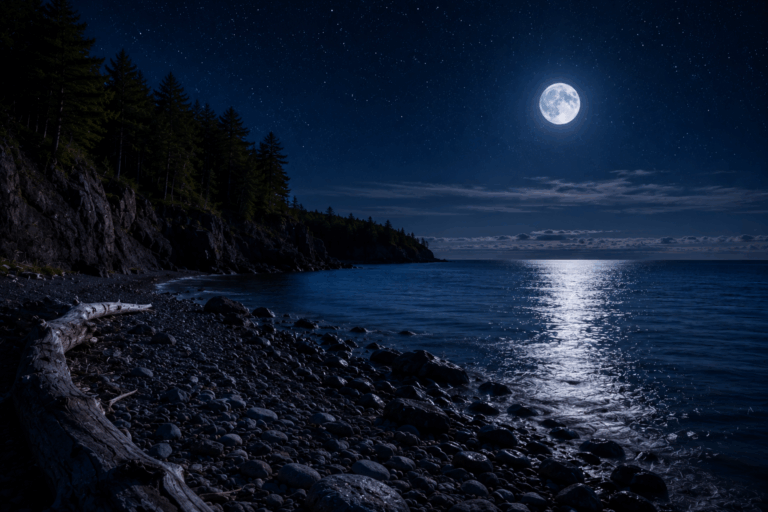
The Full Moon and Partial Lunar Eclipse of August 27-28, 2026: The Sturgeon Moon and a Rare Celestial Event
On August 27, 2026, the Moon reaches its full phase at 10:19 Central Time (04:19 UTC on August 28). At that exact moment, the Moon will be positioned on the opposite side of Earth as the Sun, allowing its entire near side to be fully illuminated by sunlight. This alignment creates the brilliant full Moon that has inspired skywatchers throughout history. While the Moon appears full for about a day before and after the exact phase, astronomers define the full Moon by this precise moment of alignment.
The August full Moon is traditionally known as the Sturgeon Moon. The name comes from early Native American tribes living around the Great Lakes and other major waterways, where large sturgeon fish were most easily caught during late summer. These ancient fish have existed for more than 150 million years and were an important food source for Indigenous communities. Their seasonal abundance made the August full Moon a dependable marker of one of the year’s most productive fishing periods.
The August full Moon also carries several other traditional names. It has been called the Green Corn Moon, reflecting the time when corn reached maturity but had not yet fully dried for harvest. It has also been known as the Grain Moon, recognizing the harvesting of wheat, barley, oats, and other grains across much of the Northern Hemisphere.
The August 2026 Sturgeon Moon is especially noteworthy because it is accompanied by a partial lunar eclipse. This is a very deep lunar eclipse, with 96.2% coverage of the moon predicted. During this event, part of the Moon will pass through Earth’s darkest shadow while the remainder stays outside it. Unlike a total lunar eclipse, only a portion of the Moon will darken. Even so, it promises to be one of the year’s most impressive astronomical events. The eclipse will be visible throughout most of North America, Mexico, Central America, South America, the Atlantic Ocean, and much of Europe and Africa.
The Astronomy Behind the August 2026 Full Moon
A full Moon occurs when the Sun, Earth, and Moon reach nearly perfect alignment. Earth occupies the middle position, allowing sunlight to fully illuminate the side of the Moon facing our planet. Astronomers call this arrangement opposition.
In the US, the August 27, 2026 full opposition of the moon occurs at 8:19 PM on the West Coast and 11:19 PM on the East Coast. Depending on where you live, the exact moment may occur during the evening or overnight hours. Fortunately, the Moon will appear completely full throughout much of the surrounding night.
Like every full Moon, the Sturgeon Moon rises near sunset and sets near sunrise. It reaches its highest point around local midnight. During this phase, it becomes the brightest object in the night sky after the Sun.
As summer gradually gives way to autumn, the August full Moon follows a slightly higher path across the sky than the June and July full Moons. This allows many observers to enjoy the Moon higher above the horizon for a longer portion of the night.
Why It Is Called the Sturgeon Moon
The Sturgeon Moon is one of the oldest surviving full Moon names in North America. The name originated among Native American tribes living near the Great Lakes, Lake Champlain, and other large freshwater lakes.
Late August was an ideal time to catch lake sturgeon. These massive fish often gathered in predictable locations, making them easier to harvest. Sturgeon could grow to remarkable sizes, sometimes exceeding six feet in length and weighing well over one hundred pounds. They provided an important source of food and were highly valued by Indigenous communities.
The annual return of the sturgeon harvest became closely associated with the August full Moon. Long before written calendars, this lunar marker helped people recognize an important seasonal event.
Although sturgeon populations have declined significantly in modern times, conservation efforts have helped restore these remarkable fish in several regions. Today, the Sturgeon Moon continues to honor both the species and the cultural traditions connected with it.
Other Traditional Names for August’s Full Moon
Many cultures developed their own names for the August full Moon based on seasonal changes and agricultural activities.
One of the most common is the Green Corn Moon. Corn had reached full size by late August, but many fields still contained green ears that were not yet fully dry. This stage represented an important point in the growing season, and many communities celebrated the coming harvest.
Another traditional name is the Grain Moon. Across Europe and much of North America, late summer marked the beginning of grain harvests. Wheat, barley, oats, and rye were gathered before autumn rains arrived. The bright full Moon often provided additional evening light for farmers working long hours in the fields.
Some European traditions referred to this Moon as the Fruit Moon because orchards and berry patches were producing abundant crops. Others called it the Barley Moon, emphasizing one of the region’s most important cereal crops.
Although these names vary, they all celebrate the abundance of late summer and the approaching harvest season.
The Partial Lunar Eclipse of August 27-28, 2026
The most exciting feature of the August 2026 full Moon is the accompanying partial lunar eclipse with 96.2% coverage.
A lunar eclipse occurs only during a full Moon, when Earth passes directly between the Sun and the Moon. Most full Moons do not produce eclipses because the Moon’s orbit is tilted slightly relative to Earth’s orbit around the Sun. Only when the alignment is especially close does the Moon pass through Earth’s shadow.
During a partial lunar eclipse, only part of the Moon enters Earth’s darkest shadow, known as the umbra. The remaining portion stays within the lighter outer shadow, called the penumbra, or outside the shadow entirely.
As the eclipse progresses, observers will notice a dark curved shadow slowly moving across one edge of the Moon. Unlike a total lunar eclipse, the Moon will never become completely red. Instead, a distinct section of the lunar surface will appear noticeably darker and a bit coppery while the remainder stays brightly illuminated.
The curved edge of Earth’s shadow provides a beautiful demonstration that our planet is spherical. This same observation helped ancient Greek astronomers recognize Earth’s shape more than two thousand years ago.
Where the Eclipse Will Be Visible
The August 27-28 partial lunar eclipse will be visible across a large portion of the world.
Observers throughout most of North America will have an excellent opportunity to watch the event. It will also be visible from Mexico, Central America, South America, much of the Atlantic Ocean, and large portions of Europe and Africa.
Unlike a solar eclipse, which is visible only along a narrow path, a lunar eclipse can be seen from anywhere the Moon is above the horizon during the event. This makes lunar eclipses among the most widely observed astronomical phenomena.
No special equipment is required. The eclipse is completely safe to observe with the unaided eye, binoculars, or telescopes.
Viewing the Sturgeon Moon Across North America
The August full Moon offers excellent viewing opportunities across North America.
In the western United States, the Moon rises into warm late summer skies. Desert regions and higher elevations often provide crisp, steady views. The eclipse should be easy to follow as Earth’s shadow slowly advances across the lunar disk.
Across the Midwest, the Sturgeon Moon shines above fields preparing for harvest. Corn and soybean fields stretch across the landscape, making the Green Corn Moon name especially meaningful. If skies remain clear, observers will be able to watch the gradual progress of the eclipse while enjoying comfortable evening temperatures.
Along the East Coast, the Moon rises above forests, beaches, and city skylines. Coastal observers may enjoy beautiful reflections across lakes and the Atlantic Ocean. Urban viewers will have no difficulty seeing the eclipse despite city lights because the full Moon is exceptionally bright.
Constellations of the Late Summer Sky
Although the full Moon brightens the sky considerably, many bright stars and constellations remain visible.
The Summer Triangle dominates the eastern sky. Its three bright stars, Vega, Deneb, and Altair, remain among the easiest stars to identify throughout late summer.
To the south, Sagittarius and Scorpius continue to occupy the region surrounding the center of the Milky Way. Although the Moon washes out much of the Milky Way’s faint glow, the bright red star Antares remains easy to locate.
The constellation Cygnus, the Swan, flies high overhead during August evenings. Its long cross shaped pattern becomes increasingly prominent as the night progresses.
As August comes to an end, the first hints of autumn also begin appearing. The Great Square of Pegasus starts rising in the east later in the evening, signaling that another seasonal transition is approaching.
The Moon’s Surface During Full Phase
The Sturgeon Moon provides excellent opportunities to study the Moon’s broad surface features.
Dark volcanic plains called maria stand out clearly against the brighter lunar highlands. Mare Imbrium, Mare Serenitatis, and Mare Tranquillitatis are all visible without optical aid.
During the partial eclipse, these familiar features gradually fade where Earth’s shadow passes across them. Watching recognizable landmarks disappear into darkness adds another level of interest to the event.
Binoculars reveal even greater detail. Bright ray systems from impact craters remain visible on the illuminated portion of the Moon while the eclipsed section becomes noticeably dimmer.
Photography Tips for the Eclipse
The August eclipse provides excellent opportunities for photographers.
Unlike photographing a total lunar eclipse, exposure changes during a partial eclipse are more moderate. The illuminated portion of the Moon remains very bright, while the eclipsed section darkens considerably.
A tripod helps produce sharp images. Taking photographs every few minutes creates a sequence showing Earth’s shadow slowly moving across the lunar surface.
Wide angle photographs can also capture the Moon rising above landscapes while the eclipse is underway. Including trees, lighthouses, mountains, or city skylines provides a strong sense of scale.
Why the August Full Moon Is Special
The August Sturgeon Moon represents the richness of late summer. Crops are approaching harvest. Wildlife remains active. Warm evenings encourage people to spend time outdoors before cooler autumn weather arrives.
This year, the partial lunar eclipse adds another layer of excitement. Watching Earth’s shadow slowly cross the Moon reminds us that celestial events unfold with remarkable precision. The same orbital mechanics that produce the regular cycle of lunar phases also create these occasional eclipses.
Generations of observers have watched eclipses with wonder. Today we understand the science behind them, but their beauty remains unchanged.
Conclusion
The Full Moon of August 27- 28, 2026 reaches its peak at 04:19 UTC on August 28, when the Moon stands opposite the Sun and its face is fully illuminated. Known as the Sturgeon Moon, it celebrates the time when large sturgeon were most easily caught in the Great Lakes and other major waterways. Other traditional names, including the Green Corn Moon and the Grain Moon, recognize the approaching harvest season and the abundance of late summer.
This year’s Sturgeon Moon is made even more memorable by a partial lunar eclipse. As part of the Moon passes through Earth’s darkest shadow, observers across much of North America, Central America, South America, Europe, and Africa will witness one of the year’s most impressive astronomical events.
Whether you watch the Moon rise over a quiet lake, a mountain ridge, a rural field, or a city skyline, the August 2026 Sturgeon Moon offers a wonderful reminder of the beauty and precision of the night sky. It marks the transition from summer toward autumn while connecting us with centuries of people who also measured the seasons by the changing Moon.
Please be advised that, despite our best efforts, International Star Registry – Name a star provides astronomical content for entertainment purposes. We cannot guarantee the accuracy of all information given.