
The Delta Aquariid Meteor Shower: How to Enjoy Summer’s Graceful Shooting Stars
There is something magical about watching a meteor silently streak across the night sky. For just a brief moment, a tiny fragment of cosmic debris burns brilliantly in Earth’s atmosphere, creating what many people call a “shooting star.” Whether you make a wish or simply admire the spectacle, meteor showers are among the most enjoyable astronomical events anyone can experience.
One of summer’s most rewarding celestial displays is the Southern Delta Aquariid meteor shower. Although it is often overshadowed by the more famous Perseid meteor shower that arrives in August, the Delta Aquariids offer patient observers beautiful, graceful meteors beneath warm summer skies. Combined with the brilliant stars of the Summer Triangle and the glowing band of the Milky Way overhead, late July provides some of the finest nights of the year for simply looking up.
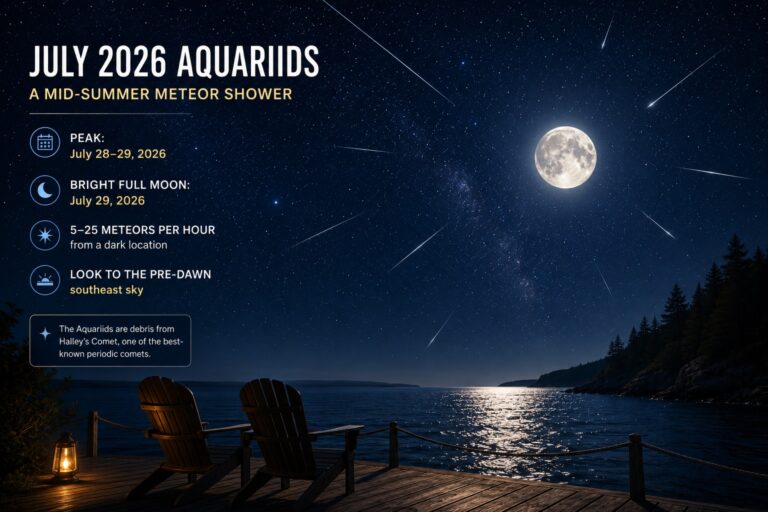
In 2026, however, there is one important factor that skywatchers should know before planning their meteor-watching adventure. The shower reaches its peak at nearly the same time as the Full Moon on July 29, meaning bright moonlight will reduce the number of meteors visible throughout the night. Fortunately, with a little planning and realistic expectations, the Delta Aquariids can still provide a memorable evening beneath the stars.
What Is the Delta Aquariid Meteor Shower?
The Southern Delta Aquariids are an annual meteor shower that occurs as Earth passes through a stream of dust and rocky debris left behind by Comet 96P/Machholz. Each summer our planet encounters these tiny particles, which enter Earth’s atmosphere at incredible speeds and burn up high above the surface, producing the bright streaks of light we call meteors.
Most of these particles are surprisingly small. Many are no larger than grains of sand, yet they travel at nearly 90,000 miles per hour (about 41 kilometers per second). At those tremendous speeds, even microscopic pieces of comet dust create beautiful flashes of light before completely vaporizing dozens of miles above Earth.
Unlike fireworks, meteor showers are entirely natural. Every shooting star you see represents a tiny piece of an ancient comet completing its final journey through our atmosphere.
Why Are They Called Delta Aquariids?
Meteor showers receive their names from the constellation where their meteors appear to originate.
If you trace the paths of the Delta Aquariid meteors backward, they seem to emerge near the star Delta Aquarii in the constellation Aquarius, the Water Bearer. Astronomers call this point the radiant.
The meteors are not actually coming from Aquarius. Instead, this is simply a perspective effect, much like railroad tracks appear to meet at a distant point on the horizon.
Fortunately, you don’t need to stare directly at Aquarius to enjoy the shower. Many of the longest and most beautiful meteors appear far away from the radiant, streaking gracefully across large sections of the sky.
When Does the Shower Peak?
The Delta Aquariids are active from mid-July through late August, giving observers several weeks to enjoy the display.
The shower usually reaches its greatest activity around July 29 or July 30, when observers under dark skies can often see 15 to 20 meteors per hour, with even higher rates possible farther south where the radiant climbs higher above the horizon.
Unlike meteor showers that have a brief, dramatic peak lasting only a few hours, the Delta Aquariids build gradually and remain active for several nights before and after maximum. This gives observers several opportunities to enjoy the display if weather conditions interfere on the peak night.
The Full Moon’s Effect in 2026
For skywatchers in 2026, the timing of this year’s shower presents a unique challenge.
The Full Moon occurs on July 29, 2026, almost exactly when the Delta Aquariids reach their peak. While this makes for a beautiful summer night, it also creates brighter skies that significantly reduce the visibility of fainter meteors.
Moonlight acts much like light pollution. Instead of seeing the faintest meteors that would normally flash across a dark sky, observers will mostly notice only the brighter ones.
This does not mean the meteor shower is canceled or that nothing will be visible. Bright meteors will still streak across the sky, and an occasional especially brilliant meteor may leave a glowing trail behind it. However, instead of seeing perhaps 15 to 20 meteors each hour under ideal dark conditions, observers may see only a fraction of that number because the moonlight overwhelms many of the dimmer streaks.
Fortunately, the Delta Aquariids remain active for several weeks. If your schedule allows, consider observing during the week before the Full Moon, when the Moon sets earlier or is less illuminated. Although meteor activity will be slightly below its absolute peak, the darker skies often allow many more meteors to become visible.
Best Viewing in the Northern Hemisphere
Although the Delta Aquariids favor observers in the Southern Hemisphere, they are still an excellent sight throughout much of the Northern Hemisphere.
The best viewing conditions occur:
Between midnight and dawn.
Around 2:00 to 4:00 a.m. local time.
Away from city lights.
Under the darkest skies available.
During these early morning hours, your location on Earth is facing forward along our planet’s orbit around the Sun, allowing you to encounter more meteoroids.
Even with the Full Moon present, it is still worth getting outside. The brightest meteors can remain quite impressive, especially if you are observing from a rural location.
A Bonus Meteor Shower
Late July offers another pleasant surprise.
The Alpha Capricornid meteor shower is also active during this time. While it produces relatively few meteors, it is famous for generating exceptionally bright fireballs that move slowly across the sky.
These brilliant meteors are bright enough that many remain visible even when moonlight interferes with fainter meteors.
Because both showers occur simultaneously, patient observers may enjoy fast Delta Aquariids followed by an occasional dazzling Alpha Capricornid fireball.
The Milky Way Still Steals the Show
Although the Full Moon will brighten the sky near the shower’s peak, there are still many reasons to spend time outdoors.
During late July, the magnificent Summer Triangle stands nearly overhead, formed by the brilliant stars Vega, Deneb, and Altair. These three stars serve as a gateway to one of the richest regions of the Milky Way.
Earlier in the observing period, before the Moon becomes full, the Milky Way stretches brilliantly across the sky, revealing countless stars, dark dust lanes, and distant star clouds.
Even on moonlit nights, the Summer Triangle remains easy to identify and provides a wonderful backdrop while waiting for meteors to appear.
Do You Need a Telescope?
One of the best things about meteor showers is their simplicity.
No telescope is required.
In fact, telescopes actually make meteor watching more difficult because they show only a tiny portion of the sky.
Instead, bring a reclining lawn chair or blanket and simply look upward. The wider your view of the sky, the greater your chances of catching a meteor.
Binoculars can be enjoyable for exploring star clusters or the Moon itself after your meteor watching session, but they are not necessary for observing the shower.
Tips for Successful Meteor Watching
A little preparation can make your evening far more enjoyable.
Choose a viewing location far from city lights whenever possible.
Allow your eyes about 20 to 30 minutes to adapt to the darkness, even if moonlight is present.
Avoid checking bright phone screens, which reduce your night vision.
Dress comfortably, bring insect repellent if needed, and settle into a reclining chair that allows you to comfortably view large sections of the sky.
Most importantly, be patient. Meteor showers naturally come in waves. You may see several meteors within a few minutes, followed by a quieter period before activity increases again.
Photographing the Shower
Photographing meteors can be a rewarding challenge.
A digital camera with a wide-angle lens mounted on a tripod works well. Use exposures of 15 to 30 seconds while continuously taking images throughout the night.
Moonlight from the Full Moon will brighten your photographs considerably in 2026, so shorter exposures or lower ISO settings may produce cleaner images. While capturing numerous faint meteors may be more difficult than during darker years, the bright Moon can beautifully illuminate landscapes, creating dramatic photographs that feature both the night scenery and an occasional bright meteor.
Enjoy This Annual Treat
Although the Full Moon will reduce meteor counts during the 2026 peak, the Delta Aquariids remain one of summer’s most enjoyable celestial events. Warm evenings, comfortable temperatures, and the beautiful backdrop of the Summer Triangle make late July an excellent time to spend a few quiet hours beneath the stars.
If your goal is to see the greatest possible number of meteors, consider observing several nights before the Full Moon, when darker skies will reveal many more of the shower’s fainter streaks. If you choose to observe on the night of the peak itself, simply adjust your expectations and enjoy the brightest meteors that manage to shine through the moonlight.
Every shooting star is a tiny fragment of an ancient comet that has traveled through the solar system for thousands or even millions of years before ending its journey in Earth’s atmosphere. For a brief instant, that tiny particle lights up the sky, reminding us that our planet is part of a much larger and ever-changing universe.
Whether you spend the evening in your backyard, beside a quiet lake, or on the deck of a sailboat, the Delta Aquariid meteor shower offers an opportunity to slow down, appreciate the beauty of the night sky, and enjoy one of summer’s timeless celestial traditions. Even under the light of the Full Moon, looking up remains one of the simplest and most rewarding ways to connect with the wonders of the cosmos.
Please be advised that, despite our best efforts, International Star Registry – Name a star provides astronomical content for entertainment purposes. We cannot guarantee the accuracy of all information given.