
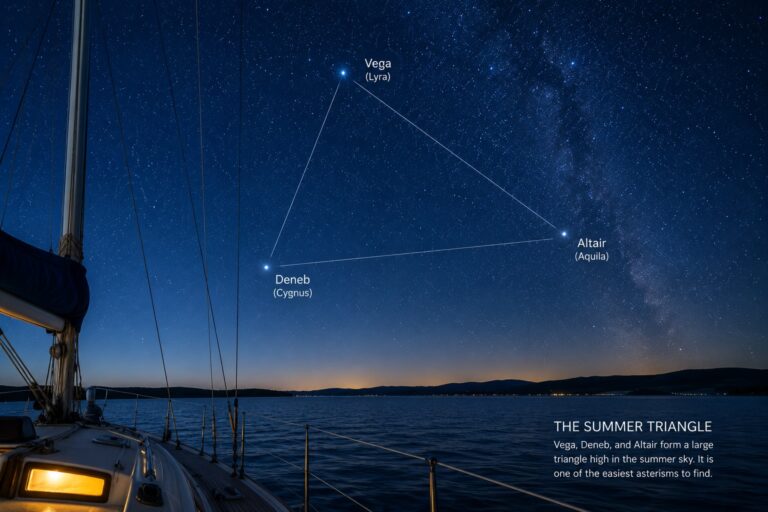
The Summer Triangle: Your Guide to One of the Night Sky’s Most Beautiful Landmarks
On warm summer evenings, as twilight slowly fades and the stars begin to appear, one of the easiest and most rewarding sights in the northern sky emerges overhead. Unlike a constellation, this celestial landmark is made up of three brilliant stars from three different constellations, forming a huge triangle that stretches across the Milky Way. Known as the Summer Triangle, it has guided skywatchers, sailors, astronomers, and curious stargazers for generations.
One of the reasons the Summer Triangle is so popular is because it is incredibly easy to find. Even people who have never explored the night sky before can usually identify it within a few minutes. Once you learn to recognize these three bright stars, they become a gateway to dozens of other constellations, deep-sky objects, and some of the most beautiful regions of our galaxy.
Whether you’re relaxing on your backyard patio, camping beneath dark skies, or enjoying an evening aboard a sailboat, the Summer Triangle is one of the finest celestial sights of the year.
What Is the Summer Triangle?
The Summer Triangle is an asterism, which is a recognizable pattern of stars that is not officially classified as a constellation. While many people confuse it with a constellation, an asterism simply connects stars that appear to form a familiar shape in the sky.
The Summer Triangle consists of three exceptionally bright stars:
Together these three stars create an enormous triangle spanning roughly 35 degrees of sky. To put that into perspective, your clenched fist held at arm’s length covers about 10 degrees. The Summer Triangle is therefore over three fists wide, making it impossible to miss once you know where to look.
Although these stars appear close together from Earth’s perspective, they are separated by enormous distances in space. They simply happen to lie in roughly the same direction when viewed from our planet.
The Three Stars of the Summer Triangle
Vega: The Brilliant Beacon
Vega is usually the first star people notice on summer evenings. Shining with a striking blue-white color, it is the brightest star in the constellation Lyra and one of the brightest stars visible anywhere in the night sky.
Located about 25 light-years from Earth, Vega is relatively close in astronomical terms. It is approximately twice the size of our Sun and around forty times more luminous, producing its brilliant appearance.
Thousands of years ago, Vega served as Earth’s North Star because of the slow wobble of Earth’s rotational axis, a phenomenon known as precession. In approximately 12,000 years, Vega will once again become the Pole Star, replacing Polaris for future generations.
Astronomers have also discovered a large disk of dust surrounding Vega, making it one of the first stars where evidence of a planetary system was detected.
Deneb: A Stellar Giant
At the opposite corner of the Summer Triangle lies Deneb, the brightest star in the constellation Cygnus, the Swan.
Deneb is astonishingly luminous. While estimates of its exact distance vary because of measurement challenges, it is generally believed to be about 2,600 light-years away. Despite this tremendous distance, it still appears among the brightest stars in our sky.
Its incredible visibility is due to its immense energy output. Deneb is a blue-white supergiant that shines roughly 200,000 times brighter than our Sun, making it one of the most luminous stars visible to the naked eye.
Cygnus itself resembles a graceful swan flying along the Milky Way. Many observers also recognize this pattern as the “Northern Cross,” making it another easy shape to identify once the Summer Triangle has been located.
Altair: The Swift Spinner
The third corner belongs to Altair, the brightest star in Aquila, the Eagle.
Altair lies only about 17 light-years from Earth, making it one of our relatively close stellar neighbors. It is famous for spinning at an incredible speed. While the Sun takes about a month to rotate once, Altair completes a rotation in roughly nine hours.
This rapid rotation causes the star to bulge outward around its equator, giving it an oblate shape instead of a perfect sphere.
Altair is often accompanied by two dimmer stars that sit on either side of it, creating a distinctive line that makes identification easy once you know where to look.
When Is the Summer Triangle Best Viewed?
Despite its name, the Summer Triangle is visible for much of the year. However, it reaches its finest viewing position during the Northern Hemisphere summer.
The best months are:
June
July
August
September
During June, the triangle begins climbing into the eastern sky after sunset.
By July and August, it stands high overhead during the evening hours, making this the ideal time for observation.
In September, it remains beautifully positioned during the early evening before gradually shifting westward.
Although the Summer Triangle can still be seen well into autumn and even early winter, it gradually sinks toward the western horizon after sunset.
Finding the Summer Triangle
One of the greatest pleasures of astronomy is learning to navigate the sky without electronic assistance.
To locate the Summer Triangle:
Find a location away from bright city lights.
Allow your eyes about 20 to 30 minutes to adapt to the darkness.
Look high toward the eastern sky during early summer evenings or nearly overhead during midsummer.
Locate Vega, usually the brightest star overhead.
Find Deneb slightly northeast of Vega.
Look southeast to find Altair.
Once these three bright stars are connected in your imagination, the enormous triangular shape becomes unmistakable.
The Summer Triangle and the Milky Way
One of the most spectacular aspects of the Summer Triangle is its location within the Milky Way.
Under dark skies, the glowing river of our galaxy flows directly through the triangle. This portion of the Milky Way contains rich star fields, glowing nebulae, dark dust lanes, and countless distant stars.
Using only binoculars, observers can explore:
Dense star clouds
Colorful double stars
Bright nebulae
Numerous open star clusters
Sweeping binoculars slowly through Cygnus is often one of the most memorable experiences for beginning astronomers.
A Gateway to Deep-Sky Objects
The Summer Triangle serves as a convenient starting point for finding many fascinating celestial objects.
Within this region are several favorites:
The Ring Nebula (M57) in Lyra is the remains of a dying Sun-like star and appears as a tiny smoke ring through telescopes.
The Dumbbell Nebula (M27) in Vulpecula was the first planetary nebula ever discovered and is visible even with modest amateur equipment.
The Coathanger Cluster (Collinder 399) can also be found in Vulpecula and forms a charming coat hanger shape that is particularly attractive through binoculars.
The North America Nebula (NGC 7000) lies near Deneb and resembles the outline of the North American continent in long-exposure photographs.
These objects demonstrate why the Summer Triangle region is one of astronomy’s richest observing areas.
Ancient Legends Behind the Stars
Although the Summer Triangle itself is a modern name, the constellations it connects have inspired stories for thousands of years.
The ancient Greeks imagined Lyra as the magical harp of Orpheus, whose music could charm animals and even move stones.
Cygnus represented a graceful swan associated with several Greek myths involving Zeus and transformation.
Aquila, the Eagle, symbolized the mighty bird that carried Zeus’s thunderbolts across the heavens.
In East Asian astronomy, these same stars tell a very different story.
Altair represents the cowherd Niulang, while Vega represents the weaving princess Zhinü. According to the famous legend, the lovers are separated by the celestial river of the Milky Way and are permitted to reunite only once each year when magpies form a bridge across the sky. This beautiful tale is celebrated during the annual Qixi Festival in China and Tanabata in Japan.
Why the Summer Triangle Is Perfect for Beginners
Many constellations require patience and practice to recognize. The Summer Triangle is different.
Its stars are bright.
Its shape is enormous.
Its location is easy to remember.
Because it remains visible for many months, new observers have plenty of opportunities to become familiar with it.
Once you’ve learned the Summer Triangle, finding neighboring constellations such as Lyra, Cygnus, Aquila, Sagitta, Vulpecula, and Delphinus becomes much easier.
Many amateur astronomers consider it the first major stepping stone toward learning the entire night sky.
Tips for the Best Viewing Experience
You don’t need expensive equipment to enjoy the Summer Triangle.
For the best experience:
Choose a moonless evening whenever possible.
Observe from a location away from city lights.
Bring a reclining lawn chair or blanket so you can comfortably look upward.
Allow your eyes time to adapt to darkness by avoiding bright phone screens.
Binoculars can greatly enhance your view by revealing countless stars invisible to the naked eye.
If you own a small telescope, explore the Ring Nebula, colorful double stars, and the rich star fields that fill this region of the Milky Way.
A Familiar Friend Every Summer
The Summer Triangle has welcomed generations of skywatchers long before modern astronomy existed. Farmers watched it rise above their fields, sailors used its bright stars for navigation, and families gathered beneath it during warm summer nights.
Today, it continues to inspire wonder just as it always has.
Unlike many astronomical events that occur only once or twice each year, the Summer Triangle faithfully returns every summer, inviting us to step outside, look upward, and reconnect with the universe.
Whether you’re introducing a child to the stars for the first time, photographing the Milky Way, or simply enjoying a peaceful evening beneath a clear sky, these three brilliant stars provide a reliable guide to some of the richest celestial scenery visible from Earth.
The next time darkness settles on a warm summer evening, find Vega, Deneb, and Altair shining high above. Together they form more than just a triangle of stars. They serve as a timeless reminder that some of the universe’s greatest wonders require nothing more than a clear sky, a little curiosity, and the willingness to look up.
Please be advised that, despite our best efforts, International Star Registry – Name a star provides astronomical content for entertainment purposes. We cannot guarantee the accuracy of all information given.