
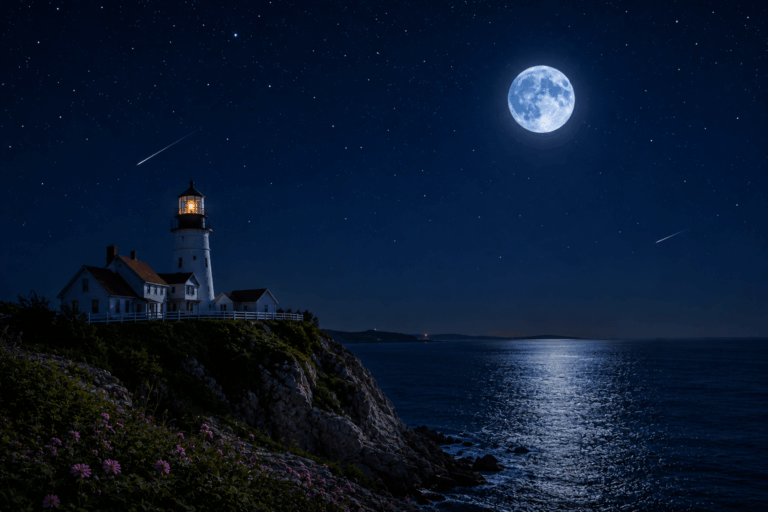
The Lights of Summer, See the Full Buck Moon and a Summer Sky Filled with Shooting Stars
On July 29, 2026, the Moon reaches its full phase at 14:37 UTC. At that exact moment, the Moon will be located on the opposite side of Earth from the Sun, allowing its entire near side to be fully illuminated by sunlight. This alignment creates the bright, round disk that has inspired people around the world for thousands of years. Although the exact full phase occurs at one precise instant, the Moon will appear full for the night before and after the event, giving skywatchers plenty of opportunities to enjoy one of summer’s brightest celestial sights.
July’s full Moon is traditionally known as the Buck Moon. The name comes from early Native American tribes that noticed male deer, or bucks, begin growing new antlers during this time of year. Their antlers are among the fastest growing tissues in the animal kingdom, and by midsummer they are covered in a soft layer of velvet that supplies nutrients while they continue to develop. The annual return of new antlers became a dependable sign that summer was reaching its midpoint.
The July full Moon has also been called the Thunder Moon because thunderstorms are common across much of North America during midsummer. Another traditional name is the Hay Moon, recognizing the busy hay harvest that took place on farms throughout Europe and North America. These names remind us that people once relied on the changing seasons and the Moon’s regular cycle to help mark important times of the year.
The July 2026 Buck Moon also arrives during one of the year’s best periods for meteor watching. The Southern Delta Aquariid meteor shower is active during the second half of July and reaches its peak around July 30. Although the bright full Moon will reduce the number of meteors visible during the peak, patient observers may still catch some of the brighter shooting stars streaking across the summer sky.
The Astronomy Behind the July 2026 Full Moon
A full Moon occurs when the Sun, Earth, and Moon line up in nearly a straight line. Earth sits between the Sun and the Moon, allowing sunlight to fully illuminate the side of the Moon facing our planet. Astronomers call this position opposition.
For the July 29, 2026 full Moon, opposition occurs at 14:37 UTC. Depending on where you live, this may happen during daylight hours. Fortunately, the Moon appears full throughout much of the evening before and after the exact moment, so observers will still enjoy an impressive view after sunset.
Like every full Moon, the Buck Moon rises near sunset and sets near sunrise. It reaches its highest point around local midnight. Since it reflects sunlight directly toward Earth, it becomes the brightest object in the night sky after the Sun.
Unlike the low riding Strawberry Moon of June, the July Buck Moon begins climbing slightly higher each evening as the seasons slowly progress toward autumn. Even so, it still follows a relatively low path compared with the full Moons of winter.
Why It Is Called the Buck Moon
The Buck Moon is one of the oldest traditional Moon names still used today. Many Native American tribes carefully observed the annual growth cycle of white tailed deer and other native species. During July, mature bucks begin growing a fresh set of antlers after shedding the previous year’s rack.
At first, these antlers are covered with velvet, which contains blood vessels that nourish the rapidly growing bone beneath. Over the coming weeks, the antlers continue expanding until they eventually harden before autumn. The annual appearance of new antlers provided an easily recognized seasonal milestone.
The Buck Moon became closely associated with strength, renewal, and the natural cycle of wildlife. Long before modern calendars, these repeating patterns helped communities measure the passage of time.
Other Traditional Names for July’s Full Moon
Different cultures gave July’s full Moon names that reflected local weather, agriculture, and seasonal activities.
The Thunder Moon became popular because July often brings powerful afternoon and evening thunderstorms across much of North America. Warm temperatures combine with abundant moisture to create towering thunderclouds that can produce dramatic lightning displays. A bright full Moon rising after a summer storm has inspired countless photographers and skywatchers.
The Hay Moon originated in farming communities where July marked the busiest period for cutting, drying, and storing hay. Farmers depended on favorable weather to gather enough hay to feed livestock through the coming winter. A bright full Moon often provided additional light for evening work during this busy season.
Some European traditions also referred to July’s full Moon as the Mead Moon, continuing the connection between summer harvests and honey production. Beekeepers often found their hives thriving during midsummer as flowers continued blooming across fields and gardens.
Although the names differ, they all celebrate abundance, growth, and the richness of midsummer.
The Buck Moon and the Southern Delta Aquariid Meteor Shower
One of the most interesting aspects of the July 2026 full Moon is that it coincides with the annual Southern Delta Aquariid meteor shower. This meteor shower is active from mid July through much of August and reaches its broad peak around the night of July 30. Under dark skies, observers may normally see fifteen to twenty meteors per hour.
Unfortunately, the nearly full Buck Moon will brighten the sky considerably during the shower’s peak. Its light will wash out many of the fainter meteors. The brightest meteors, however, can still be visible, especially after midnight when the radiant climbs higher in the southern sky.
The Southern Delta Aquariids originate from debris left behind by Comet 96P/Machholz. Each July, Earth passes through this stream of tiny particles. As they enter Earth’s atmosphere at tremendous speed, they burn up and create the brief flashes of light we call meteors.
Observers who wish to see more meteors may have better luck several days before or after the full Moon, when moonlight becomes less intense.
Viewing the Buck Moon Across North America
The July Buck Moon is easy to observe from anywhere with a clear eastern horizon.
In the western United States, the Moon rises into warm summer twilight. Dry desert air and mountain elevations often produce exceptionally sharp views. The Moon may appear golden as it climbs above distant ridges before gradually becoming bright white later in the evening.
Across the Midwest, the Buck Moon rises above fields filled with corn, soybeans, and other summer crops. Warm temperatures and occasional humidity may soften the Moon’s edges slightly, creating a gentle glow around the lunar disk.
Along the East Coast, the Moon often rises above forests, beaches, and city skylines. Reflections across lakes and the Atlantic Ocean can create beautiful scenes. Thin summer haze sometimes gives the Moon a warm amber color shortly after moonrise.
No matter where you observe, the Moon appears largest near the horizon because of the well known Moon illusion. Although the Moon does not actually change size, nearby buildings, trees, and hills make it seem much larger than when it is high overhead.
Summer Constellations Surrounding the Full Moon
Even though the Buck Moon brightens the sky, many of summer’s brightest stars remain visible.
The Summer Triangle dominates the eastern sky. It is formed by the brilliant stars Vega, Deneb, and Altair. These three stars become some of the easiest landmarks for beginning stargazers.
To the south, Scorpius stretches across the horizon with its bright red star Antares marking the heart of the Scorpion. Nearby, Sagittarius points toward the center of the Milky Way Galaxy. Under dark skies, this region contains countless star clusters and glowing nebulae, although many become difficult to see during a full Moon.
The familiar Big Dipper remains high in the northern sky. Following the curve of its handle leads to Arcturus, one of the brightest stars visible during summer evenings.
The Moon’s Surface During Full Phase
The Buck Moon provides excellent opportunities for casual lunar observing.
Large dark regions known as maria are easy to identify without optical aid. These ancient lava plains formed billions of years ago after enormous asteroid impacts fractured the Moon’s crust and allowed molten rock to flood the basins.
Binoculars reveal additional detail. Bright ray systems extend across the surface from relatively young impact craters such as Tycho and Copernicus. Although shadows are minimal during the full phase, differences in brightness between the lunar highlands and maria remain easy to appreciate.
Photography Tips for the Buck Moon
Warm summer evenings make July one of the best months for lunar photography.
The most dramatic photographs are usually taken during moonrise. At that time, the Moon appears larger because of the Moon illusion and often displays beautiful orange or golden colors caused by Earth’s atmosphere.
Including trees, barns, lighthouses, mountains, or city skylines in the foreground creates a strong sense of scale. A tripod helps keep images sharp, especially when using longer focal lengths.
Photographers interested in capturing both the Buck Moon and an occasional meteor should use a wide angle lens and be prepared for long periods of patient observation. Although moonlight will reduce the number of visible meteors, a bright Delta Aquariid can still make for an unforgettable image.
Why the July Full Moon Continues to Inspire
The Buck Moon arrives during one of the most enjoyable times of year for spending evenings outdoors. Families gather for camping trips, vacations, backyard barbecues, and nights beneath the stars. Warm temperatures make it easy to remain outside long after sunset.
For thousands of years, people have watched this same Moon rise over forests, rivers, mountains, and open plains. Hunters noticed the growth of deer antlers. Farmers watched hay fields ripen. Communities listened to distant summer thunderstorms while the bright Moon climbed overhead.
Although modern life has changed dramatically, the Buck Moon continues to connect us with those seasonal traditions. It reminds us that nature follows rhythms that remain remarkably consistent from one year to the next.
Make a Night of it!
The Full Moon of July 29, 2026 reaches its peak at 14:37 UTC, when the Moon stands opposite the Sun and its face is fully illuminated. Known as the Buck Moon, it celebrates the time when male deer begin growing their new antlers. Other traditional names, including the Thunder Moon and the Hay Moon, reflect the weather patterns and agricultural rhythms of midsummer.
This year’s Buck Moon is especially interesting because it coincides with the Southern Delta Aquariid meteor shower. While the bright Moon will reduce the number of visible meteors, observers may still catch some of the brighter shooting stars crossing the summer sky.
Whether you watch it rise above distant mountains, quiet lakes, rolling farmland, or a city skyline, the July Buck Moon offers another opportunity to appreciate the beauty of the night sky. It serves as a reminder that the changing seasons, the steady rhythm of the Moon, and the wonders of the universe continue to unfold above us every month.
Please be advised that, despite our best efforts, International Star Registry – Name a star provides astronomical content for entertainment purposes. We cannot guarantee the accuracy of all information given.