
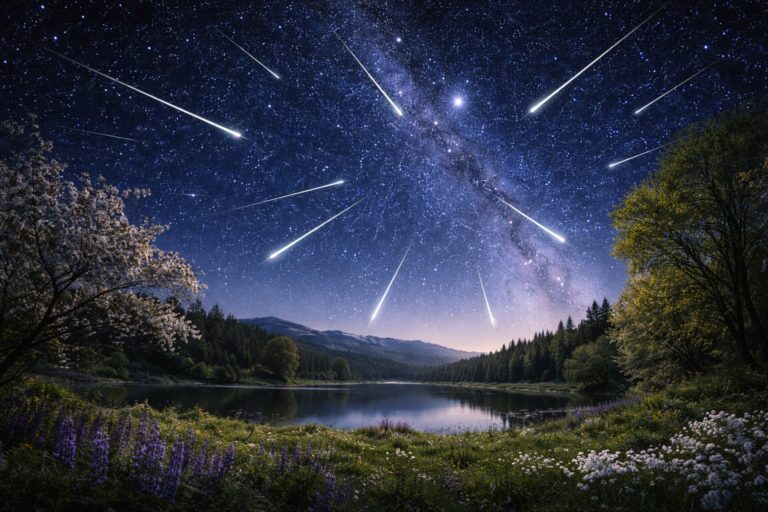
The Lyrid Meteor Shower 2026: A Classic Springtime Display Under Dark, Moon-Friendly Skies
Each spring, as winter finally loosens its grip and evenings grow more comfortable, the night sky offers one of its most reliable and historically rich celestial events: the Lyrid Meteor Shower. In 2026, the Lyrids are shaping up to be a particularly rewarding show, thanks to excellent Moon conditions and a peak that favors observers across the Northern Hemisphere.
The Lyrid Meteor Shower peaks on the night of April 22 and the early morning of April 23, 2026. This year, the Waxing Crescent Moon will set shortly after midnight, leaving dark skies during the shower’s most active hours. With minimal moonlight interference and a reliable hourly rate of around 20 meteors per hour, the Lyrids offer skywatchers a calm yet captivating cosmic experience with some bright meteors and lingering dust trails.
Here’s what you need to know about the 2026 Lyrid Meteor Shower: its ancient history, celestial mechanics, viewing tips, Moon conditions, radiant location, and why this understated shower remains a favorite among experienced observers.
What Are the Lyrids?
The Lyrids are one of the oldest recorded meteor showers in human history, with observations dating back more than 2,700 years. While they may not match the intensity of the Perseids or Geminids, the Lyrids are admired for their consistency, elegance, and occasional surprises. They may even including sudden outbursts and bright, slow-burning meteors that leave glowing trails in the sky.
The shower is active each year from April 16 through April 25, with a relatively narrow peak that usually lasts one to two nights. In 2026, that peak arrives at an ideal time for late-night observers.
Lyrid Meteor Shower 2026: Key Dates and Details
Active period: April 16–25, 2026
Peak: Night of April 22 into the morning of April 23
Peak rate: ~20 meteors per hour (under dark skies)
Moon phase: First Quarter (Waxing Crescent Moon)
Moonset: Shortly after midnight
Best viewing: After midnight until dawn
Best region: Northern Hemisphere
The combination of Moon setting early and peak activity occurring after midnight makes 2026 a particularly favorable year for the Lyrids.
Moon Conditions in 2026: Nearly Ideal
Moonlight is often the deciding factor in whether a meteor shower becomes a casual curiosity or a truly memorable event. In 2026, observers will be fortunate.
During the Lyrids peak:
The Moon will be only 28% illuminated when it is in the sky
It will set shortly after midnight, before peak viewing
The darkest skies will coincide with the shower’s most active hours
This that faint meteors will be easier to spot because the contrast will be higher. The viewer may also be treated to more dust trails, which will stand out more clearly in the dark sky.
Once the Moon dips below the horizon, observers can enjoy hours of uninterrupted darkness, making this an excellent year for both beginners and seasoned skywatchers.
The Comet Behind the Lyrids
Every meteor shower has a parent body, and the Lyrids originate from one of the most famous long-period comets associated with meteor activity. This comet, called Comet C/1861 G1 Thatcher was discovered by both by A. E. Thatcher and Carl Wilhelm Baeker when it last reached perihelion (closest approach to the sun) in 1861.
It is a slow moving comet with an orbital period of roughly 415 to 422 years, but although it will not appear again in our lifetimes, it leaves behind a persistent stream of dust particles which the Earth passes through each year.
As Earth passes through this debris stream each April, tiny grains of debris, many of which are no larger than grains of sand, slam into our atmosphere at incredible speeds, vaporizing in flashes of light. These burning dust particles are seen from Earth as meteors, often called shooting stars, falling stars, or in some cases, fireballs.
Though the comet itself won’t return for over 250 years, its dusty legacy continues to delight observers every spring.
Why the Lyrids Are Considered an “Average” Shower—But Still Special
With peak rates of around 20 meteors per hour, the Lyrids are often described as an “average” meteor shower. But numbers alone don’t tell the whole story.
What makes the Lyrids unique includes the special treat of spotting occasional bright fireballs, the long-lasting dust trains that may linger in the night sky for several seconds, and the surprising nature of the shower, with unpredictable outbursts recorded throughout history
Some years have produced sudden spikes of activity, with rates briefly exceeding 50–100 meteors per hour. While such outbursts are impossible to predict far in advance, the possibility adds an element of excitement to every Lyrid watch.
A Meteor Shower with Ancient Roots
The Lyrids hold a special place in astronomical history.
They were first recorded thousands of years ago. Mentions of the Lyrids meteor shower can be found dating back to 687 BCE in Chinese chronicles. These shooting stars have been observed throughout the Northern hemisphere by civilizations across Asia, the Middle East, and Europe
These beautiful showers are exceedingly lovely, often described as “stars falling like rain”
Few celestial events can claim such a long and continuous observational record. When you watch the Lyrids, you’re participating in a tradition that stretches back thousands of years.
Where Do the Lyrids Appear in the Sky?
Lyrid meteors radiate from the constellation Lyra, home to one of the brightest stars in the night sky, Vega. Lyra can be seen in the northeastern sky rising in the evening before midnight and rising higher in the sky during peak viewing hours.
Important Viewing Notes
You do not need to look directly at the constellation Lyra. Lyrid meteors can appear anywhere in the sky and appear to radiate from that constellation. Good locatons to check might be its neighboring constellations Draco, Hercules, Vulpecula, and Cygnus.
Ideal observation requires a mostly cloudless sky. If there will be clouds on the night the meteor shower peaks, check the night before.
Find a dark area and give your eyes time to adjust to the darkness. Make this a late night activity, although some meteors may be viewed all night long in the darkest, clearest area of the sky available.
Lyra rises higher in the sky after midnight, which is why the post-midnight hours offer the best viewing conditions.
Why the Northern Hemisphere Has the Best View
The Lyrids strongly favor Northern Hemisphere observers, where Lyra climbs high overhead during the peak hours.
The constellation Lyra sits 25.66° to 47.71° north of the celestial equator. For observers in North America, Europe and Northern Asia the radiant is well positioned, allowing for better meteor counts and longer visible streaks.
Southern Hemisphere viewers may see a handful of meteors, but the radiant remains low, significantly reducing activity.
Speed, Brightness, and Dust Trails
Lyrid meteors enter Earth’s atmosphere at speeds of around 30 miles per second (49 km/s) which is fast enough to create brilliant streaks but slow enough to allow persistent trains to form.
If you see these dust trails the will appear as smoky, glowing ribbons. You may find that they mimic a the spiral past of the debris entering Earth’s atmosphere, causing them to twist and distort for several seconds.
These amazing streaks of light are especially visible under clear, dark skies.
In 2026, with the Moon setting early, observers have an excellent chance of seeing these delicate, beautiful aftereffects.
Best Time to Watch the Lyrids in 2026
Prime Viewing Window
For the best show, check the sky between 12:30 a.m. and Dawn, April 23
This is the time when Lyra has risen from the horizon and is high in the sky. Also at this time, the Earth is rotating directly into the debris stream and moonlight is minimal or absent.
Earlier evening hours may still produce meteors, but rates will be noticeably lower.
How to Watch the Lyrids: Practical Tips
1. Find Dark Skies
Avoid lighted cities and populous lighted areas
Avoid creating light. Keep the lights around you to a minimum so your eyes can adjust. Avoid screens and phone apps.
2. Dress Comfortably
April meteor watching can be a cold but cozy event. Bring a thermos and consider wearing gloves and a hat.
Bring layers, a blanket, or a reclining chair
3. Skip the Equipment
No telescope or binoculars are needed. Consider this equipment if you are planning on viewing other sky objects and planets.
This requires full sky viewing. Your naked eye provides the widest field of view
4. Let Your Eyes Adjust
Allow your eyes 20 to 30 minutes in the dark for full dark adaptation
Avoid bright screens. It may be tempting to check astronomy apps or your phone, but this will reduce your ability to see the streaks of light when they happen!
5. Be Patient and Make it Fun
Meteor watching is about time. This is a time for hanging out with your watch buddy or contemplating the beauty of the night sky. It’s not a time for instant results.
Don’t give up or think the show is over. Rates fluctuate naturally.
Photographing the Lyrids in 2026
Thanks to favorable Moon conditions, 2026 is a good year for astrophotography.
Camera Tips
Wide-angle lens (14–24mm)
ISO 1600–3200
10–20 second exposures
Continuous shooting mode
Aim toward the darkest part of the sky, preferably 30–60 degrees away from the radiant for longer meteor streaks.
Comparing the Lyrids to Other Meteor Showers
| Meteor Shower | Peak Rate | Season | Notable Features |
|---|---|---|---|
| Lyrids | ~20/hr | April | Ancient, dust trails |
| Perseids | 50–60/hr | August | Bright, frequent |
| Geminids | 100+ | December | Slow, colorful |
| Quadrantids | 30–40/hr | January | Sharp, short peak |
The Lyrids may not overwhelm the sky, but they reward careful observation with elegance and history.
Why the Lyrids Are Perfect for Beginners
For those new to meteor watching, the Lyrids offer several advantages:
These are the first meteors since January, you might enjoy spring temperatures.
Lyra rises high in the sky all night, making manageable viewing hours.
You can plan ahead for your watch party. The Lyrids promise predictable activity at the same time every year.
This year especially, there is minimal Moon interference in 2026.
They’re an ideal “first meteor shower” that builds confidence and appreciation for the night sky.
Cultural and Scientific Importance
Meteor showers like the Lyrids help scientists:
Study cometary debris streams
Understand long-period comet behavior
Analyze atmospheric interaction
For cultures past and present, they’ve symbolized:
Change and renewal
Celestial omens
Humanity’s connection to the cosmos
Catch a “Falling Star”, Watch the Lyrid Meteor Shower in 2026
The Lyrid Meteor Shower of 2026 offers a rare combination of:
Reliable meteor activity, allowing you to plan in advance for this annual event.
Dark, Moon-friendly skies, especially this year when the Waxing Cresent moon sets before Lyra rises high in the sky.
Comfortable spring weather. This is the first meteor shower of spring, and a great way to welcome the warm weather ahead.
Centuries-old celestial tradition. People in continents around the world have viewed the dependable, historic Lyrid Meteor shower for thousands of years.
While it may not flood the sky with meteors, the Lyrids deliver something equally valuable: moments of quiet wonder, punctuated by sudden streaks of light that seem to bridge past and present.
Set your alarm, step outside after midnight, and look up. Under dark April skies, the Lyrids remind us that even the most subtle cosmic events can leave a lasting impression. 🌠
Please be advised that, despite our best efforts, International Star Registry – Name a star provides astronomical content for entertainment purposes. We cannot guarantee the accuracy of all information given.